Saarloos Wolfdog: Your Complete Guide
The first thing most people notice about the Saarloos wolfdog is its wild appearance. The fluid movement, piercing gaze, and wolf-like silhouette give the breed an unmistakably untamed presence.
Unlike most domestic dogs, Saarloos wolfdogs have unique behavior. The way they think, react, and bond with people can surprise even experienced dog owners.
If you’re thinking about buying or adopting a Saarloos wolfdog, you’ll want to know a few things. Whether they are affectionate or distant, if they get along with children and other pets, how much exercise they need, and how difficult they are to train. These factors are important because this breed doesn’t adapt easily to every household or lifestyle.
Table of Contents
Quick Look at the Saarloos Wolfdog
Below is a quick breakdown of the Saarloos wolfdog’s most important traits to help you understand the breed’s needs and tendencies.
| Weight/Height | Males: 66-90 lbs, 24-30 in
Females: 60-79 lbs, 23-28 in |
| Coat Type | Thick, dense, short-to-medium double coat |
| Grooming Needs |  |
| Shedding |  |
| Temperament | Lively, trustworthy, independent, proud, good-natured |
| Good With Kids | |
| Good With Other Animals | |
| Intelligence | |
| Easy to Train | |
| Energy Level |  |
| Barking Habits |  |
| Lifespan | 10-12 years |
What Is the History of Saarloos Wolfdogs?
The Saarloos wolfdog originated in the Netherlands in the 1930s, created by Dutch breeder Leendert Saarloos. Saarloos believed that modern dog breeds, particularly German shepherds, had become too domesticated and had lost much of their natural strength, resilience, and instinctive behavior.
His goal was not to create a pet dog, but rather one that retained more natural wolf traits while still being capable of living alongside humans. To achieve this, Saarloos obtained a female wolf from the Rotterdam Zoo and crossed her with a male German shepherd.
To balance the wolf traits, Saarloos continued breeding the offspring back with German shepherds until the dogs carried about one-quarter wolf blood. While the dogs were physically impressive, their temperament did not match Saarloos’s expectations. They were quiet, cautious, and less assertive than he had hoped.
Despite this, Saarloos continued refining the breed until he died in 1969. After his passing, other breeders carried on his work, and the breed was officially recognized by the Dutch Kennel Club in 1975 as the Saarloos wolfdog. International recognition followed in 1981, with the United Kennel Club recognizing the breed in 2006.
What Do Saarloos Wolfdogs Look Like?




The Saarloos wolfdog is a tall, strong dog that closely resembles wolves in body structure and gait. Long legs and a lean frame give the breed an athletic appearance. Males and females are easy to tell apart due to clear secondary sex characteristics.
The head forms a clean wedge shape that mirrors that of a wolf. A flat, broad skull and gentle stop keep the face balanced. The muzzle is the same length as the skull and blends smoothly into the head without appearing coarse. Strong pigmentation on the nose enhances facial contrast. The teeth are white, evenly spaced, and meet in a scissor bite.
What truly sets the breed apart are its eyes. They’re almond-shaped, range from yellow to amber, and are set slightly at an angle. Ears are medium-sized, triangular with rounded tips, and sit level with the eyes. A low-set tail hangs straight or curves gently in a saber shape.
Saarloos wolfdogs have a narrow chest that reaches the elbows. A straight back and lightly tucked abdomen maintain a slim profile.
Coat colors commonly include wolf-grey, brown, cream, and white, with lighter undersides and darker facial markings. Seasonal coat changes can slightly alter the dog’s overall appearance throughout the year.
What Size Is a Saarloos Wolfdog?
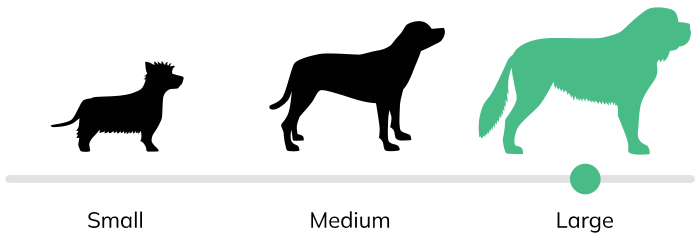
Saarloos wolfdogs are large dogs, though their slim build can sometimes make them appear lighter than they actually are. Males usually stand between 24 and 30 inches tall (61-76 cm) and weigh between 66 and 90 lbs (30-41 kg). Females are slightly smaller, averaging 23 to 28 inches in height (58-71 cm) and 60 to 79 lbs in weight (27-36 kg).
Individual dog size can vary based on lineage, nutrition, and overall health, but extremes outside these ranges are unacceptable by the breed standard for well-bred dogs.
What Is a Saarloos Wolfdog’s Coat Type and Length?


A Saarloos wolfdog has a double coat that changes noticeably with the seasons. In winter, the undercoat becomes thick and dominant, creating a dense layer on the skin. This gives the dog a full, protective coat that covers the entire body. A visible ruff also forms around the neck during colder months.
When summer arrives, the coat changes in both texture and volume. The outer guard hair becomes more prominent, and the undercoat starts thinning. Despite this change, a light undercoat should always be present.
The belly, the inside of the upper thighs, and the scrotum remain covered with hair year-round. Overall coat length is medium, with the hair lying close to the body without feathering or curl.
What Is a Saarloos Wolfdog’s Temperament?
The Saarloos wolfdog exhibits a proud, independent temperament from an early age. These dogs aren’t naturally submissive and prefer to make their own decisions. They choose when to cooperate, and you’ll see their confidence and self-direction in everyday behavior.
Loyalty toward their owner runs deep. Once you earn a Saarloos wolfdog’s trust, they become reliable, affectionate, and emotionally connected.
In unfamiliar situations, these dogs tend to withdraw or keep their distance, often approaching strangers with caution. This natural reserve is part of the Saarloos wolfdog personality. It’s not a good idea to force interaction, restrict movement, or use excessive control with this breed.
Are Saarloos Wolfdogs Good With Kids?
These dogs aren’t aggressive toward children, but they’re not naturally child-focused either. Their temperament leans toward caution and emotional sensitivity. High noise levels, constant interaction, sudden movements, and unpredictable behavior from toddlers can be stressful for them.
Calm, older children are usually easier for this breed to accept. You should teach the kids to respect the dog’s signals and give them space. Nobody should grab, pull, chase, corner, or handle the dog roughly. It’s also important to teach children how to greet the dog when they first meet and to notice early signs of stress.
When raised alongside children in a stable environment, Saarloos wolfdogs can become gentle and tolerant, but they’re not naturally playful or patient like family dogs. Supervision is important at all times, especially during early interactions.
Are Saarloos Wolfdogs Good With Other Animals?
A Saarloos wolfdog introduced to other animals early in life finds it easier to live in a multi-pet household. This breed usually gets along well with other dogs of similar size and temperament.
If you’re planning to get a Saarloos wolfdog puppy and already have a dog, it’s a good idea to expose them to each other right away rather than waiting until adulthood. The first time you introduce your new puppy to your dog, do so in a neutral environment. It’s also best done gradually.
With smaller animals, however, Saarloos wolfdogs need extra care and supervision. This breed has a natural prey drive that may trigger chasing behavior toward cats, rabbits, or rodents. Early training does help, but instinct can’t be entirely trained out. You need to provide secure spaces for smaller pets at all times.
Are Saarloos Wolfdogs Aggressive?
Saarloos wolfdogs aren’t aggressive. Avoidance is their first response when faced with stress or unfamiliar situations.
Aggressive behavior, when it appears, is usually linked to fear or poor handling. Forced interaction, lack of space, or harsh training methods can increase stress. These dogs need freedom to move away from situations that make them uncomfortable.
When you respect their needs, Saarloos wolfdogs rarely show aggressive behavior. Positive training also helps prevent fear-based reactions in these dogs.
Do Saarloos Wolfdogs Bark?
This breed is generally quieter than many others. Instead of barking excessively, Saarloos wolfdogs communicate through body language, posture, and subtle vocalizations. This trait makes them suitable for quieter neighborhoods. They don’t do well in apartments, though, because they need ample space and outdoor access.
You may also notice howling on occasion, mainly in response to certain sounds. Overall, you can help keep this breed’s vocal behavior low with proper exercise and mental stimulation.
Are Saarloos Wolfdogs Affectionate?
Yes, these dogs are affectionate in their own way. They’re not lapdogs and rarely seek constant physical contact. They enjoy being close to immediate family members and choose when and how to interact. This isn’t to say that Saarloos wolfdogs don’t get attached or aren’t loyal. Their affection tends to be more subtle and personal.
With strangers, affection is limited or absent. They take time to warm up to new people, so never rush the process.
Are Saarloos Wolfdogs Intelligent?

Yes, their intelligence shows in how closely they observe their surroundings. They notice changes in routine, environment, and human behavior very quickly. Awareness and memory are their strongest traits.
Saarloos wolfdogs have strong problem-solving skills, but their independence shapes how they use their intelligence. Their behavior is often driven by curiosity. They like to assess a situation and think before acting. When motivated, they can learn new things very quickly.
Are Saarloos Wolfdogs Energetic?
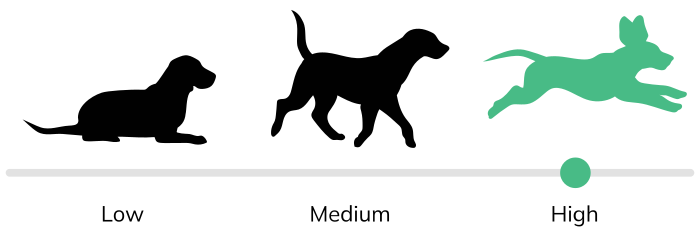
Yes, daily activity is a basic need for this breed. Families should expect to commit time every day to physical activity. Long walks are great, but they’re not enough on their own.
Off-leash movement is especially important for Saarloos wolfdogs. Running freely in a secure environment allows them to relax and reset mentally. Families with fenced property or access to private outdoor spaces have a clear advantage.
You also need to provide adequate mental stimulation. Exploring new places and following scent trails keeps them engaged. A family that enjoys hiking and outdoor routines will find this breed easier to manage.
Are Saarloos Wolfdogs Easy to Train?
Saarloos wolfdogs are not easy to train in the usual sense. They’re intelligent, but they don’t enjoy being told what to do. This breed prefers to make its own choices, so training works best when the dog understands why something matters.
It’s best to start with simple commands and reward the desired behaviors instantly. Don’t repeat the same instructions over and over, as it can cause frustration. Also, short sessions are more effective than long ones.
This breed is capable of learning complex behaviors and advanced tricks, as long as you don’t resort to punishment when they make a mistake or don’t listen right away. Harsh correction can damage trust and slow progress. You need to make sure training is a positive experience for your Saarloos wolfdog, so they feel motivated to keep learning.
Are Saarloos Wolfdogs Good Watchdogs?
These dogs have strong environmental awareness. They stay alert even when resting, which means unfamiliar sounds or movements around the house rarely go unnoticed. They may bark to let you know when something is different. This suggests they can be good watchdogs.
However, they aren’t naturally protective or confrontational. Instead of guarding territory, they tend to keep a distance from unfamiliar people. You can’t expect defensive behavior from this breed.
Are Saarloos Wolfdogs Good Service Dogs?
Saarloos wolfdogs are generally not suited for service dog work. Service dogs need to stay calm and focused in busy public spaces, but this breed is sensitive to stress and unfamiliar situations. Crowds, noise, and constant interaction can easily overwhelm them.
Independence also plays a role. Saarloos wolfdogs prefer making their own choices instead of following strict commands. Service work requires reliability and quick responses, even when a dog is tired or distracted. While Saarloos wolfdogs are intelligent, their temperament makes it difficult for them to perform consistently.
In most cases, other breeds are a better and more practical choice for service roles.
How to Care for a Saarloos Wolfdog?
This breed feels most secure when daily routines are predictable. Sudden changes can make them uneasy. Keep regular walking times, rest periods, and quiet hours to reduce stress.
A household with shouting, pressure, or constant excitement can also cause withdrawal in Saarloos wolfdogs. We recommend setting up a designated spot in the house for the dog to retreat to when overwhelmed.
A secure yard or access to open, safe outdoor areas is also very important for this breed. When they’re given the chance to engage in natural movement, these dogs remain more emotionally stable and are easier to manage.
Do You Need to Groom a Saarloos Wolfdog?

Yes, and fortunately, the grooming routine is fairly simple. You just have to brush the coat to keep it clean, prevent tangles and matting, and remove loose hair. A slicker brush or a firm bristle brush usually works well. If mats form, a dematting tool can help remove them gently.
Saarloos wolfdogs are good at keeping themselves clean, so baths are rarely needed unless the dog becomes very dirty or develops a strong odor. Keep in mind that too many baths can damage the coat by drying out the skin and stripping away protective oils.
Basic care also includes trimming nails when they grow too long and brushing teeth once a week to maintain oral hygiene.
Do Saarloos Wolfdogs Shed?

Saarloos wolfdogs shed a fair amount throughout the year, so loose hair is part of daily life with this breed. Shedding increases during seasonal coat changes and is usually the heaviest during spring and fall.
While you can manage the amount of hair with regular brushing, this breed isn’t hypoallergenic. If anyone in your family is allergic, this breed may not be right for your home.
What Health Problems Do Saarloos Wolfdogs Have?
Like many large breeds, Saarloos wolfdogs are prone to joint problems. Hip and elbow dysplasia are the main health concerns. These issues can limit mobility and affect quality of life if not managed properly. Early screening and controlled activity can help reduce risk.
Less common conditions include degenerative myelopathy (it affects the spinal cord and can lead to weakness in the hind legs) and dwarfism. These issues aren’t seen in every dog, but are still important to be aware of. Eye conditions may also appear occasionally.
Regular testing plays a significant role in prevention. X-rays, eye examinations, physical exams, and blood panels help veterinarians track the dog’s health over time.
How Long Do Saarloos Wolfdogs Live?
Saarloos wolfdogs usually live between 10 and 12 years. This lifespan is typical for a breed of their size. Some individual dogs may live longer with proper care.
Good daily routines, a stable, low-stress environment, and preventive veterinary care help improve the overall quality of life and the Saarloos wolfdog lifespan.
What Should a Saarloos Wolfdog Eat?
A Saarloos wolfdog needs a high-quality diet that supports its size, activity level, and natural build. Many owners choose food that closely matches what a wolf would eat in the wild. This includes raw meat, organs, and raw bones.
If you’d like to follow this approach, raw muscle meat, such as chicken, turkey, beef, or game, should form the main part of the diet. You can add raw meaty bones to the mix to help provide calcium and support dental health. Cooked bones should never be given because they can splinter.
Organs like the liver and kidneys are a good choice, as they’re packed with vitamins and minerals. Healthy fats can come from fatty meats or fish oil.
Some owners choose premium large-breed dog food instead, or mix it with raw ingredients. Small amounts of safe fruits and vegetables can also be included.
Is a Saarloos Wolfdog the Right Dog for Me?
This breed does best with experienced dog owners who understand independent canine behavior. First-time owners might find the temperament challenging. Make sure you’re comfortable working with a Saarloos wolfdog’s natural instincts before deciding to bring them home.
With regular outdoor time, positive training, and predictable routines, a Saarloos wolfdog can live a happy and balanced life with you.